
The Love2Learn Framework: Environment Is Everything

Environment Is Everything

“The environment is not the backdrop for learning. It is one of the greatest teachers a child will ever have.”

If you’ve spent any time around Love2Learn, you’ve probably heard us say:

“Environment is everything.”

It’s more than a slogan.

It’s the foundation of everything we do.

Every policy we create, every classroom we design, every teacher we hire, and every decision we make begins with one question:

“What kind of environment does this create for children?”

Why?

Because before children learn from worksheets, books, or lesson plans, they learn from the world around them.


Children Are Always Learning From Their Environment

Long before children can explain their feelings with words, they are making observations.

They notice whether adults speak calmly or impatiently.

They notice whether mistakes are met with encouragement or frustration.

They notice whether classrooms feel peaceful or chaotic.

They notice whether they belong.

In many ways, children are constantly asking themselves one question:

“Is this a safe place for me?”

When the answer is yes, remarkable things begin to happen.

Curiosity grows.

Confidence develops.

Friendships form.

Learning follows.


Environment Is More Than the Classroom

When people hear the word environment, they often picture shelves, toys, paint colors, and classroom decorations.

Those things certainly matter.

But they are only the visible part of the environment.

At Love2Learn, environment also includes:

  • The emotional tone of the classroom.
  • The relationships between teachers and children.
  • The way adults speak to one another.
  • The daily routines and transitions.
  • The amount of noise and stimulation.
  • The expectations for behavior.
  • The opportunities children have to explore independently.
  • The sense of safety and belonging every child experiences.

Children don’t separate these things into categories.

They experience them as one complete environment.


The Invisible Environment

Some of the most important parts of a classroom cannot be seen.

Can a child trust the adults around them?

Do they know what to expect each day?

Do they feel comfortable asking for help?

Are mistakes treated as opportunities to learn?

Do teachers genuinely enjoy being with children?

These invisible qualities shape a child’s experience just as much as any curriculum.

In fact, they often shape it more.


Environment Shapes Behavior

One of the biggest misconceptions about young children is that behavior exists independently of the environment.

In reality, behavior is often a form of communication.

Children who are overwhelmed may become impulsive.

Children who feel disconnected may seek attention in challenging ways.

Children who don’t know what to expect may struggle with transitions.

Rather than asking,

“What’s wrong with this child?”

we try to ask,

“What is this environment communicating to this child?”

That simple shift changes everything.

Sometimes the most effective way to support a child isn’t to change the child.

It’s to improve the environment around them.


Why Small Decisions Matter

Parents are sometimes surprised by the amount of thought that goes into what seem like small decisions.

Why do we emphasize consistent routines?

Why do we encourage children to arrive before 9:30?

Why did we remove televisions from our classrooms?

Why do we spend so much time outdoors?

Why do we encourage child-led play?

Each of these decisions is connected by a single belief:

Every choice either strengthens or weakens the environment.

We aren’t interested in creating impressive classrooms.

We’re interested in creating environments where children flourish.

The Environment Includes Adults, Too

Children are incredibly observant.

They notice how adults treat one another.

They notice whether teachers work together with kindness and respect.

They notice whether adults remain calm during stressful moments.

They notice encouragement.

They notice tension.

The environment we create as adults becomes the environment children experience.

That’s why investing in our teachers is also an investment in our children.

When teachers feel supported, respected, and valued, they are better able to create those same experiences for the children in their care.


The Goal Isn’t Perfection

Every classroom has difficult days.

Children have big emotions.

Teachers have challenging moments.

No environment is perfect.

Our goal isn’t perfection.

Our goal is intentionality.

When something isn’t working, we don’t simply ask how to fix the behavior.

We ask how we can improve the environment.

Because the environment is something we can continually shape.

And every improvement, no matter how small, has the potential to make a meaningful difference in a child’s day.


Why Environment Comes First

In the Love2Learn Framework, Environment is the foundation of the pyramid because every other level depends on it.

Children are more likely to connect with teachers when they feel safe.

Teachers can better attune to children’s needs in a calm, predictable setting.

Continuous improvement is only possible when a culture of trust exists.

Excellence isn’t something we demand.

It’s something that naturally grows from a strong foundation.

Everything begins with the environment.


What We Hope Children Feel

When a child walks into Love2Learn each morning, our hope isn’t simply that they learn their letters or count to twenty.

We hope they feel something first.

We hope they feel:

  • Safe.
  • Welcome.
  • Capable.
  • Curious.
  • Respected.
  • Loved.

Because children who feel those things become children who explore, ask questions, build friendships, solve problems, and develop confidence.

The environment makes all of that possible.

That’s why, at Love2Learn, we don’t see environment as just one part of early childhood education.

We believe it is the foundation upon which everything else is built.


References & Further Reading

  • Center on the Developing Child at Harvard University. Serve and Return Interaction Shapes Brain Architecture. https://developingchild.harvard.edu
  • National Association for the Education of Young Children (NAEYC). Developmentally Appropriate Practice Position Statement. https://www.naeyc.org
  • Zero to Three. Responsive Relationships and Early Learning. https://www.zerotothree.org
  • Montessori, M. The Absorbent Mind.
  • Shonkoff, J. P., & Phillips, D. A. (Eds.). From Neurons to Neighborhoods: The Science of Early Childhood Development.

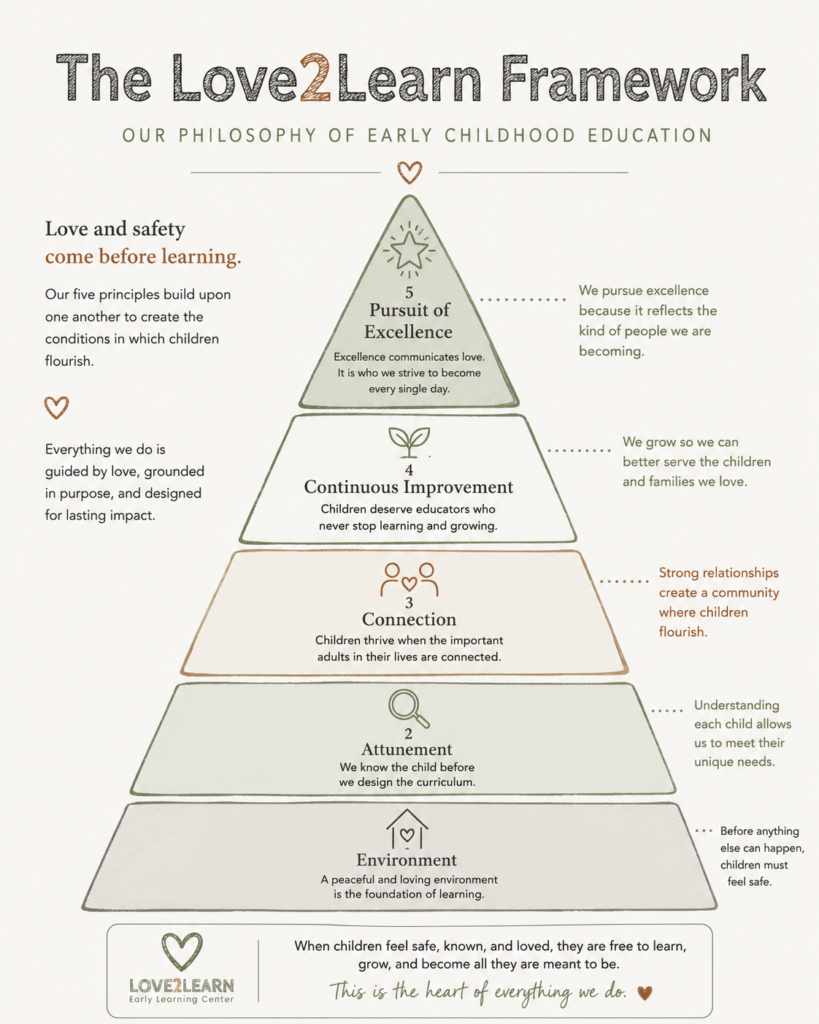
The Love2Learn Framework: How Great Learning Environments Are Built

Framework

When parents tour preschools, they often ask about the curriculum.

What will my child learn?

Will they be ready for kindergarten?

How will you prepare them for school?

These are important questions. But at Love2Learn, we believe something comes first.


Before children can truly learn, they need the right environment.

Over the years, we’ve developed a framework that guides every decision we make, from how we design our classrooms to how we hire teachers and support families.

We call it the Love2Learn Framework.Rather than focusing only on academic outcomes, our framework recognizes that children’s growth happens layer by layer. Each level builds upon the one beneath it, creating the foundation for lifelong learning.

At first glance, the pyramid may seem simple.

But each level represents an essential ingredient in helping children thrive.


1. Environment

Everything begins with the environment.

When we talk about environment, we don’t just mean the classroom furniture or the toys on the shelves.

Environment includes:

  • The relationships children experience
  • The daily routines
  • The emotional climate
  • The physical space
  • The expectations for behavior
  • The way teachers communicate
  • The sense of belonging children feel

Children are constantly absorbing their surroundings.

A calm, welcoming environment helps children feel safe enough to explore, build friendships, take healthy risks, and develop confidence.

This is why so many of our decisions—from limiting late drop-offs to removing classroom televisions—are rooted in protecting the environment first.

Without the right environment, everything else becomes more difficult.


2. Attunement

Once children feel safe, they begin to connect.

Attunement means paying close attention to each child’s unique needs, interests, and developmental stage.

Every child develops differently.

Some children need extra encouragement.

Some crave independence.

Some communicate with words.

Others communicate through their behavior.

Our teachers work to truly know each child so they can respond with empathy, patience, and intention.

When children feel understood, they become more willing to engage with the world around them.


3. Connection

Learning happens through relationships.

Research consistently shows that strong, responsive relationships are one of the greatest predictors of healthy development.

Children learn best when they trust the adults who care for them.

At Love2Learn, connection means creating genuine relationships between:

  • Teachers and children
  • Children and their classmates
  • Families and our school community

When children feel connected, they develop confidence, resilience, and a willingness to try new things.


4. Continuous Improvement

Growth doesn’t happen all at once.

Children learn through repetition, practice, encouragement, and reflection.

The same is true for us.

As educators, we are always learning.

We reflect on what is working, look for opportunities to improve, and continue growing so we can provide the best possible experience for every child.

We believe excellence isn’t achieved through perfection.

It’s achieved through a commitment to continual growth.


5. Pursuit of Excellence

The top of our pyramid is the pursuit of excellence.

For us, excellence isn’t about creating perfect children.

It isn’t about rushing academics or expecting unrealistic performance.

Excellence means helping every child become the best version of themselves.

It means doing ordinary things with extraordinary care.

It means creating an environment where children are loved, challenged, encouraged, and inspired every single day.

When the foundation is strong, excellence becomes a natural result.


Why This Framework Matters

Every preschool has lesson plans.

Many have similar toys and similar classroom materials.

What makes a school unique is not what it owns.

It’s the philosophy behind the decisions it makes.

Our framework influences everything we do:

  • How we design our classrooms
  • How we support our teachers
  • How we welcome new families
  • How we respond to challenging behaviors
  • How we think about learning
  • How we build our community

Rather than asking, “What activity should we do today?”

We begin with a different question:

“What kind of environment will help this child thrive?”

That question shapes everything else.


A Journey We’ll Explore Together

This article is just the beginning.

Over the coming months, we’ll take a deeper look at each level of the Love2Learn Framework.

We’ll explore why environment matters so much, how strong relationships shape development, what attunement looks like in the classroom, and why we believe continuous improvement leads to excellence.

Our hope is that by sharing our philosophy, you’ll not only better understand what makes Love2Learn unique, but also discover simple ways to support your child’s development at home.

Because when children are surrounded by the right environment, cared for by attentive adults, and connected to a community that believes in them, incredible things can happen.

And that’s what Love2Learn is all about.


References & Further Reading

  • Center on the Developing Child at Harvard University. Serve and Return Interaction Shapes Brain Architecture. https://developingchild.harvard.edu
  • National Association for the Education of Young Children (NAEYC). Developmentally Appropriate Practice Position Statement. https://www.naeyc.org
  • Zero to Three. Early Development & Well-Being. https://www.zerotothree.org
  • Shonkoff, J. P., & Phillips, D. A. (Eds.). From Neurons to Neighborhoods: The Science of Early Childhood Development. National Academies Press.

The Love2Learn Framework: Connection

Framework Connection

Where Children Learn, They Belong

Think back to your favorite teacher.

Chances are, you don’t remember every lesson they taught.

But you probably remember how they made you feel.

You remember feeling encouraged.

You remember feeling believed in.

You remember feeling like you mattered.

Long after the academic lessons fade, relationships remain.

At Love2Learn, we believe one of the greatest predictors of a child’s success isn’t found in a curriculum or a classroom activity.

It’s found in the quality of the relationships they experience every day.

That’s why Connection is the third layer of the Love2Learn Framework.


Learning Begins with Relationships

Children are naturally curious.

But curiosity flourishes when children feel emotionally secure.

Research consistently shows that young children learn best through responsive, trusting relationships.

When children know they are loved, respected, and supported, they become more willing to:

  • Ask questions.
  • Try new things.
  • Make mistakes.
  • Solve problems.
  • Build friendships.
  • Persevere through challenges.

Connection doesn’t replace learning.

It makes learning possible.


Connection Is Built, Not Assumed

Relationships don’t happen automatically simply because children spend time together.

Connection grows through hundreds of small moments.

Greeting each child by name.

Sharing laughter.

Reading a favorite book together.

Comforting a child after a difficult moment.

Celebrating small accomplishments.

Listening carefully to their stories, even when they wander in unexpected directions.

These moments may seem ordinary.

Together, they become extraordinary.


Every Child Deserves to Belong

Children have a deep desire to belong.

They want to know:

“Do people like having me here?”

“Am I important?”

“Would someone notice if I was gone?”

Our goal is for every child at Love2Learn to answer those questions with an enthusiastic “yes.”

Belonging isn’t something children earn through good behavior or academic achievement.

It’s something every child deserves from the moment they walk through our doors.


Friendship Is Part of the Curriculum

Some of the most meaningful learning in preschool doesn’t happen during circle time.

It happens while building a block tower together.

Sharing crayons.

Helping a friend zip their coat.

Working through a disagreement over a toy.

These moments teach children skills they will use for the rest of their lives.

They learn empathy.

Cooperation.

Patience.

Compromise.

Forgiveness.

These aren’t “extra” lessons.

They are essential parts of growing into kind, capable people.


Families Are Part of the Connection

Connection doesn’t stop at the classroom door.

We believe children thrive when families and teachers work together.

Parents know their children better than anyone else.

Teachers have the opportunity to observe children in a unique social environment.

When those perspectives come together, everyone benefits.

That’s why we value open communication, mutual trust, and true partnership with families.

Our goal isn’t simply to care for children.

Our goal is to walk alongside the families who love them most.


Our Team Matters, Too

Children notice more than we sometimes realize.

They notice how adults speak to one another.

They notice whether teachers help each other.

They notice kindness.

They notice encouragement.

They notice respect.

The relationships between our teachers help shape the relationships our children learn to build.

Creating a connected team isn’t just good for our staff.

It’s good for every child in the building.


Connection Creates Confidence

When children know they belong, they become remarkably brave.

They’re more willing to raise their hand.

To try something difficult.

To ask for help.

To comfort a friend.

To recover after making a mistake.

Confidence isn’t something we simply teach.

It’s something children develop when they consistently experience relationships built on trust.


Connection Lasts Beyond Preschool

The letters, numbers, and songs children learn in preschool are important.

But the relationships they experience may have an even greater impact.

Children who experience healthy, responsive relationships begin to develop an inner belief:

“I matter.”

“People care about me.”

“I can trust others.”

“I have something valuable to contribute.”

Those beliefs influence how children approach friendships, school, work, and even their own families for years to come.


Why Connection Is the Heart of Love2Learn

Our name says it all.

Love2Learn.

We believe love and learning are not separate ideas.

They’re deeply connected.

Children who feel loved become children who love learning.

That’s why connection sits at the center of our framework.

A thoughtfully designed environment creates safety.

Attunement helps children feel seen.

Connection helps them feel they belong.

And once children know they belong, they are free to become exactly who they were created to be.

At Love2Learn, we hope every child leaves our classrooms with more than academic skills.

We hope they leave knowing they were known, valued, and deeply connected to a community that believed in them.

Because sometimes the most important lesson a child learns isn’t found in a book.

It’s the simple but life-changing truth:

“I belong here.”


References & Further Reading

  • Center on the Developing Child at Harvard University. Serve and Return Interaction Shapes Brain Architecture.
    https://developingchild.harvard.edu
  • National Scientific Council on the Developing Child. Young Children Develop in an Environment of Relationships.
  • National Association for the Education of Young Children (NAEYC). Developmentally Appropriate Practice Position Statement.
    https://www.naeyc.org
  • Siegel, D. J., & Bryson, T. P. The Whole-Brain Child.
  • Zero to Three. Building Strong Relationships with Young Children.
    https://www.zerotothree.org

The Love2Learn Framework: Attunement

Framework Attunement

Every Child Wants to Be Seen

Imagine walking into a room where no one really notices you.

People hear your words, but they don’t understand what you’re trying to say.

They see your behavior, but not what’s causing it.

They respond to your actions, but not your needs.

Most of us have experienced moments like that.

It’s lonely.

Now imagine the opposite.

Someone notices that you’re unusually quiet today.

They recognize when you’re excited before you even say a word.

They understand that your frustration isn’t defiance—it’s discouragement.

They adjust the way they interact with you because they know you.

That experience has a name.

It’s called attunement.

At Love2Learn, we believe attunement is one of the greatest gifts an educator can offer a child.

What Is Attunement?

Attunement is the ability to notice, understand, and respond to another person’s emotional and developmental needs.

It means looking beyond behavior to understand what a child may be communicating.

Young children often don’t have the words to say:

“I’m overwhelmed.”

“I’m nervous.”

“I’m tired.”

“I need reassurance.”

Instead, they communicate through their behavior.

Attuned teachers learn to listen to those messages.


Every Child Is Different

One of the biggest misconceptions in early childhood education is that every child should be treated exactly the same.

We don’t believe that.

Every child deserves equal love, respect, and opportunity.

But children don’t all need the same things.

One child may eagerly join a new activity.

Another may need a few extra minutes to observe first.

One child may feel secure with a quick goodbye.

Another may need a familiar routine before separating from a parent.

One child thrives with encouragement in front of the group.

Another feels more comfortable receiving quiet praise one-on-one.

Attunement means recognizing those differences and responding thoughtfully.


Looking Beneath the Behavior

One of the questions we ask ourselves most often is:

“What is this child trying to tell us?”

Behavior is communication.

A child who refuses to participate may not be stubborn.

They may feel uncertain.

A child who cries at drop-off may not simply dislike school.

They may need more time to transition.

A child who grabs toys may not be mean.

They may still be learning how to communicate their wants.

Attunement helps us move beyond reacting to behavior and toward understanding the child behind it.


Observation Is One of Our Most Important Teaching Tools

Attunement begins with careful observation.

Our teachers spend time noticing:

  • What excites each child.
  • What causes frustration.
  • How they solve problems.
  • How they communicate.
  • Who they enjoy playing with.
  • When they seem most confident.
  • When they need extra support.

These observations help us make thoughtful decisions throughout the day.

Rather than expecting every child to fit the classroom, we continually ask how the classroom can better support each child.


Attunement Doesn’t Mean Lowering Expectations

Understanding a child doesn’t mean removing every challenge.

In fact, it’s quite the opposite.

When we truly know a child, we can provide the right amount of support while still encouraging growth.

Sometimes that means offering reassurance.

Sometimes it means stepping back and allowing a child to struggle productively.

Sometimes it means gently encouraging a child to try something new.

Attunement helps us recognize the difference.


Small Moments Matter

Attunement is rarely found in grand gestures.

It happens in small, everyday moments.

A teacher notices a child looking overwhelmed during circle time and quietly invites them to sit nearby.

A toddler reaches for a favorite book after a difficult morning because the teacher remembers it helps them feel calm.

A teacher recognizes that a usually energetic child is unusually quiet and checks in with them.

These moments often last only seconds.

But to a child, they communicate something powerful:

“I see you.”


Why Attunement Comes Before Connection

Strong relationships don’t happen by accident.

They are built over time through hundreds of moments when children feel understood.

When children consistently experience adults who notice them, understand them, and respond thoughtfully, trust begins to grow.

And trust becomes connection.

Connection isn’t created by simply spending time together.

It grows because children believe the adults in their lives truly know them.

That journey begins with attunement.


Helping Children Discover Themselves

One of the beautiful outcomes of attunement is that children begin to understand themselves.

When caring adults consistently name emotions, recognize strengths, and respond with empathy, children gradually learn to do the same.

They begin to recognize:

“I’m feeling frustrated.”

“I need help.”

“I’m proud of what I accomplished.”

“I can keep trying.”

Attunement doesn’t just help children feel understood today.

It helps them develop the self-awareness they’ll carry for the rest of their lives.


The Love2Learn Difference

At Love2Learn, we don’t want children to feel like just another student in the classroom.

We want every child to feel known.

To have teachers who recognize their smile before they speak.

Who celebrate their interests.

Who notice when something feels different.

Who understand that every behavior tells a story.

Because before children can fully connect with others, they need to experience what it feels like to be truly seen.

That’s why attunement is the second layer of the Love2Learn Framework.

It transforms a safe environment into one where every child feels understood.

And from that understanding, meaningful relationships begin to grow.


References & Further Reading

  • Siegel, D. J., & Hartzell, M. Parenting from the Inside Out.
  • Center on the Developing Child at Harvard University. Serve and Return Interaction Shapes Brain Architecture. https://developingchild.harvard.edu
  • Zero to Three. Responsive Relationships and Early Development. https://www.zerotothree.org
  • National Scientific Council on the Developing Child. Young Children Develop in an Environment of Relationships.