

When parents tour preschools, they often ask about the curriculum.
What will my child learn?
Will they be ready for kindergarten?
How will you prepare them for school?
These are important questions. But at Love2Learn, we believe something comes first.
Before children can truly learn, they need the right environment.
Over the years, we’ve developed a framework that guides every decision we make, from how we design our classrooms to how we hire teachers and support families.
We call it the Love2Learn Framework.Rather than focusing only on academic outcomes, our framework recognizes that children’s growth happens layer by layer. Each level builds upon the one beneath it, creating the foundation for lifelong learning.
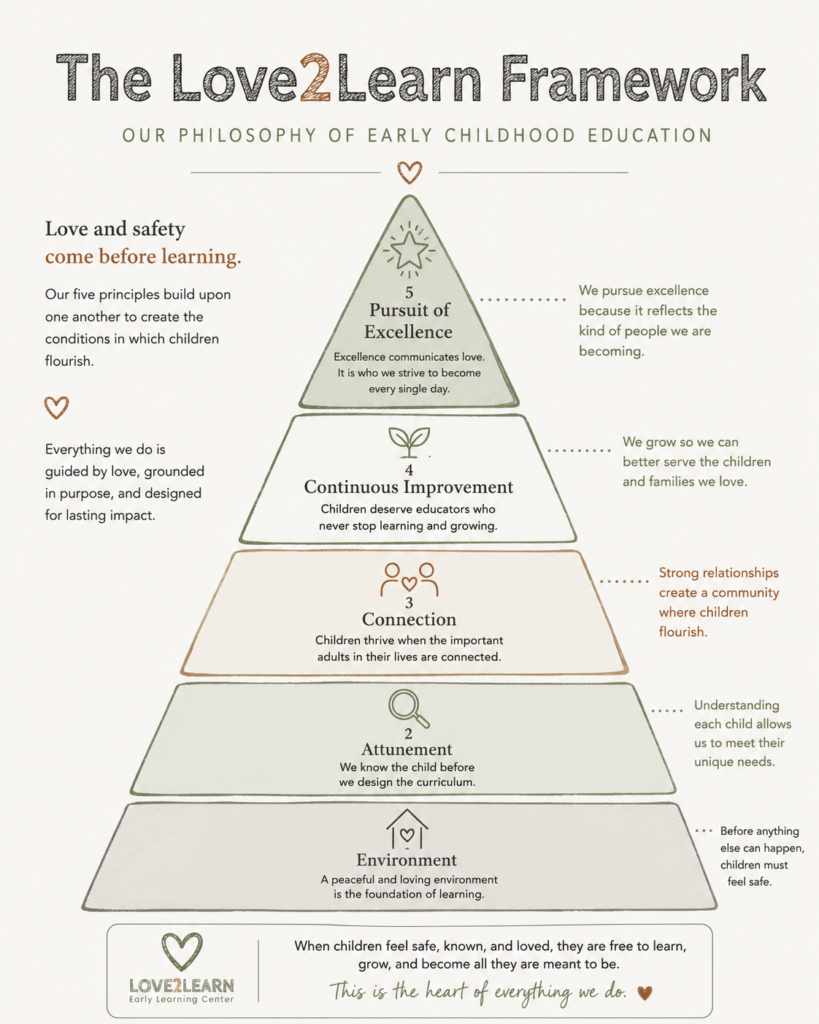
At first glance, the pyramid may seem simple.
But each level represents an essential ingredient in helping children thrive.
1. Environment
Everything begins with the environment.
When we talk about environment, we don’t just mean the classroom furniture or the toys on the shelves.
Environment includes:
- The relationships children experience
- The daily routines
- The emotional climate
- The physical space
- The expectations for behavior
- The way teachers communicate
- The sense of belonging children feel
Children are constantly absorbing their surroundings.
A calm, welcoming environment helps children feel safe enough to explore, build friendships, take healthy risks, and develop confidence.
This is why so many of our decisions—from limiting late drop-offs to removing classroom televisions—are rooted in protecting the environment first.
Without the right environment, everything else becomes more difficult.
2. Attunement
Once children feel safe, they begin to connect.
Attunement means paying close attention to each child’s unique needs, interests, and developmental stage.
Every child develops differently.
Some children need extra encouragement.
Some crave independence.
Some communicate with words.
Others communicate through their behavior.
Our teachers work to truly know each child so they can respond with empathy, patience, and intention.
When children feel understood, they become more willing to engage with the world around them.
3. Connection
Learning happens through relationships.
Research consistently shows that strong, responsive relationships are one of the greatest predictors of healthy development.
Children learn best when they trust the adults who care for them.
At Love2Learn, connection means creating genuine relationships between:
- Teachers and children
- Children and their classmates
- Families and our school community
When children feel connected, they develop confidence, resilience, and a willingness to try new things.
4. Continuous Improvement
Growth doesn’t happen all at once.
Children learn through repetition, practice, encouragement, and reflection.
The same is true for us.
As educators, we are always learning.
We reflect on what is working, look for opportunities to improve, and continue growing so we can provide the best possible experience for every child.
We believe excellence isn’t achieved through perfection.
It’s achieved through a commitment to continual growth.
5. Pursuit of Excellence
The top of our pyramid is the pursuit of excellence.
For us, excellence isn’t about creating perfect children.
It isn’t about rushing academics or expecting unrealistic performance.
Excellence means helping every child become the best version of themselves.
It means doing ordinary things with extraordinary care.
It means creating an environment where children are loved, challenged, encouraged, and inspired every single day.
When the foundation is strong, excellence becomes a natural result.
Why This Framework Matters
Every preschool has lesson plans.
Many have similar toys and similar classroom materials.
What makes a school unique is not what it owns.
It’s the philosophy behind the decisions it makes.
Our framework influences everything we do:
- How we design our classrooms
- How we support our teachers
- How we welcome new families
- How we respond to challenging behaviors
- How we think about learning
- How we build our community
Rather than asking, “What activity should we do today?”
We begin with a different question:
“What kind of environment will help this child thrive?”
That question shapes everything else.
A Journey We’ll Explore Together
This article is just the beginning.
Over the coming months, we’ll take a deeper look at each level of the Love2Learn Framework.
We’ll explore why environment matters so much, how strong relationships shape development, what attunement looks like in the classroom, and why we believe continuous improvement leads to excellence.
Our hope is that by sharing our philosophy, you’ll not only better understand what makes Love2Learn unique, but also discover simple ways to support your child’s development at home.
Because when children are surrounded by the right environment, cared for by attentive adults, and connected to a community that believes in them, incredible things can happen.
And that’s what Love2Learn is all about.
References & Further Reading
- Center on the Developing Child at Harvard University. Serve and Return Interaction Shapes Brain Architecture. https://developingchild.harvard.edu
- National Association for the Education of Young Children (NAEYC). Developmentally Appropriate Practice Position Statement. https://www.naeyc.org
- Zero to Three. Early Development & Well-Being. https://www.zerotothree.org
- Shonkoff, J. P., & Phillips, D. A. (Eds.). From Neurons to Neighborhoods: The Science of Early Childhood Development. National Academies Press.