
At Love2Learn, we are constantly asking ourselves an important question:
“Does this align with the childhood experience we want to create?”
Recently, that question led us to make a significant decision: we removed all of the televisions from our classrooms.
For some families, this may come as a surprise. We were never a screen-heavy program. In fact, the TVs were used very sparingly, typically for an occasional educational video, movement activity, or special themed lesson.
But as we reflected on our values and the type of environment we want to create, we realized something important:
Even limited screen use was not aligned with our vision for childhood.
So we made the decision to remove the TVs entirely.
Childhood Is Meant to Be Experienced, Not Watched
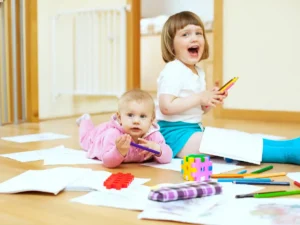
Young children learn best through active experiences.
They learn by:
- Building with blocks
- Digging in sensory bins
- Turning the pages of books
- Singing songs
- Asking questions
- Engaging in pretend play
- Talking with teachers and friends
These experiences require children to think, move, create, and interact.
A screen, no matter how educational, places children in the role of observer.
At Love2Learn, we want children to be participants.
When children are curious about butterflies, we would rather raise caterpillars.
When they are learning about construction, we would rather build.
When they are exploring music, we would rather sing and dance together.
The real world offers richer learning opportunities than any screen can provide.
Relationships Are the Heart of Learning
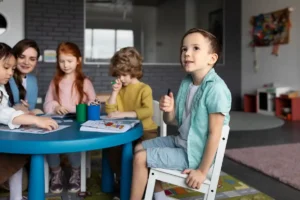
One of our core beliefs is that children learn through relationships.
The conversations between a teacher and child.
The friendships formed during play.
The questions that emerge during story time.
These interactions are where so much learning happens.
When screens are present, even occasionally, they naturally shift attention away from human connection.
By removing TVs, we are making a clear statement about what matters most in our classrooms:
People.
Not programs.
Not devices.
Not entertainment.
Relationships.
Boredom Is Not the Enemy
One concern many adults have is that children need constant stimulation.
We see things differently.
Sometimes the most meaningful learning begins when children have space to wonder, imagine, and create.
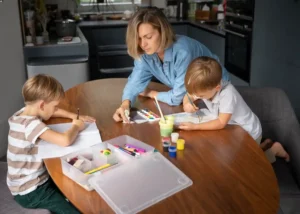
When children are not being entertained, they often:
- Invent games
- Create stories
- Build elaborate structures
- Ask thoughtful questions
- Develop problem-solving skills
These moments of creativity and independent thinking are incredibly valuable.
At Love2Learn, we want to protect opportunities for children to experience that kind of play.
The Environment Shapes Behavior
Children are deeply influenced by their surroundings.
Every item in a classroom sends a message about what is valued.
When children enter our classrooms, we want them to see:
- Books
- Art materials
- Blocks
- Dramatic play areas
- Nature materials
- Open-ended toys
We want the environment itself to invite exploration, creativity, and interaction.
Removing the TVs was one way of ensuring our classrooms reflect those priorities.
Practicing What We Preach
Many of the families who choose Love2Learn are looking for a childhood that feels slower, more connected, and less dependent on screens.
They want their children to:
- Play outside
- Build friendships
- Develop social skills
- Explore their interests
- Learn through hands-on experiences
We want our environment to fully support those goals.
Removing the TVs was a way of aligning our daily practices with the values we talk about so often.
This Decision Is About More Than Screens
Ultimately, this decision is not really about televisions.
It is about the type of childhood we believe in.
A childhood filled with:
- Conversation
- Curiosity
- Creativity
- Movement
- Relationships
- Exploration
A childhood where children are encouraged to engage with the world around them rather than watch it from a distance.
At Love2Learn, we believe those experiences matter.
And we believe they are worth protecting.
Our Commitment to Intentional Childhood
Every decision we make is guided by our mission to create an environment where children feel loved, engaged, and inspired to learn.
Removing the TVs is just one example of that commitment.
We will continue to evaluate our classrooms, our practices, and our environment through the lens of one simple question:
“Is this helping us create the childhood experience we want for our children?”
For us, the answer became clear.
And our classrooms are better because of it.
References & Further Reading
- American Academy of Pediatrics. (2018). Media and Young Minds. Pediatrics, 138(5).
- American Academy of Pediatrics. (2018). The Power of Play: A Pediatric Role in Enhancing Development in Young Children. Pediatrics, 142(3).
- Harvard Center on the Developing Child. Serve and Return Interaction Shapes Brain Architecture. https://developingchild.harvard.edu
- National Association for the Education of Young Children (NAEYC). Technology and Interactive Media as Tools in Early Childhood Programs Serving Children from Birth Through Age 8.
- Zero to Three. Screen Sense: What the Research Says About Media and Young Children. https://www.zerotothree.org