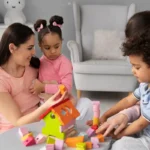

Helping little ones feel safe, confident, and connected at Love2Learn
If you’ve ever handed your toddler to a teacher while they cried and reached for you, you know the feeling.
It pulls at your heart.
It makes you question everything.
It can make mornings feel heavy.
Separation anxiety is one of the most common concerns for parents of children between 12 and 36 months. And the truth is — it’s not a sign that something is wrong.
It’s a sign that attachment is working.
At Love2Learn, we understand that secure attachment is the foundation of healthy development. That’s why our new 12–24 month classroom and our 2–3 Transition Room are intentionally designed to help children build strong, trusting relationships — even when you’re not there.
Why Separation Anxiety Happens
Between 8 months and 3 years, children develop something called object permanence — the understanding that you still exist even when you’re not visible.
The challenge? They don’t yet fully understand when you’re coming back.
This creates:
- Clinginess
- Tears at drop-off
- Hesitation in new environments
- Big feelings when routines change
Separation anxiety is actually a healthy developmental milestone. It shows your child has formed a strong bond with you.
The goal isn’t to eliminate it — it’s to support children through it.
How We Build Secure Attachments at School
Research shows that children thrive when they have consistent, responsive caregivers. That’s why attachment is central to our approach.
Here’s how we intentionally support it:
Consistent Teachers
Children see the same trusted adults every day. Familiar faces build security.
Responsive Care
When a child cries, we respond — quickly and calmly. We don’t ignore emotions; we validate them.
“You miss Mommy. She always comes back. I’m here with you.”
Predictable Routines
Toddlers feel safest when they know what happens next. Our daily structure builds confidence and trust.
Comfort Before Curriculum
In the early months, relationship comes first. Learning naturally follows once a child feels safe.
Gentle Transitions
We encourage quick, confident goodbyes — but we also work with families to ease the process gradually when needed.
What Adjustment Usually Looks Like
Most children follow a similar pattern:
- Week 1–2: Tears at drop-off, quick recovery once engaged
- Week 3–4: Shorter tears, increased participation
- After 1 Month: Confident separation, secure attachment to teachers
It’s normal for regressions to happen after illness, vacations, or schedule changes. Consistency brings them back to security.
And we always communicate with you along the way.
Why Attachment Matters for Brain Development
Secure attachment isn’t just emotional — it’s neurological.
When children feel safe:
- Their stress hormones decrease
- Their brains stay open to learning
- Their social skills strengthen
- Their resilience grows
When children feel chronically stressed, learning shuts down.
That’s why we prioritize connection above all else — especially in our 12–24 month classroom, where brain development is happening at lightning speed.
How Parents Can Support Smoother Drop-Offs
Here are a few simple strategies that help:
- Create a predictable goodbye routine
- Keep goodbyes short and confident
- Avoid sneaking out (it increases anxiety)
- Talk positively about school at home
- Trust your child’s ability to adjust
Children take emotional cues from their parents. When you show calm confidence, they learn that school is safe.
From Tears to Trust
One of the most beautiful transformations we witness is this:
- The toddler who once cried at drop-off runs into the classroom smiling.
- The child who clung tightly begins waving goodbye.
- The hesitant toddler finds comfort in a teacher’s arms.
- That transformation is secure attachment forming.
- And it’s something we protect fiercely at Love2Learn.
A Gentle Start for Growing Minds
Our new:
12–24 Month Classroom
2–3 Year-Old Transition Room
were created with attachment in mind — low ratios, responsive teachers, predictable routines, and warmth at every step.
If you’re considering enrolling your toddler and feeling nervous about separation, we understand.
Let’s talk. We’re here to support both you and your child.
Mechanicsburg, PA
Ages 1–5 | Child Care Works Accepted
(717) 553.0000
References & Further Reading
- Bowlby, J. (1969). Attachment and Loss: Volume 1. Attachment. Basic Books.
→ Foundational theory explaining how secure attachment forms and why it is essential for emotional development. - Ainsworth, M. D. S. (1978). Patterns of Attachment. Lawrence Erlbaum Associates.
→ Landmark research identifying secure, avoidant, and anxious attachment styles in young children. - Harvard University Center on the Developing Child. (2021). Serve and Return Interaction Shapes Brain Architecture.
https://developingchild.harvard.edu
→ Explains how responsive caregiving builds healthy brain development in the early years. - Zero to Three. (2022). Separation Anxiety: What to Expect and How to Help.
https://www.zerotothree.org
→ Guidance for parents navigating separation anxiety in infants and toddlers. - American Academy of Pediatrics. (2017). The Lifelong Effects of Early Childhood Adversity and Toxic Stress.
https://publications.aap.org
→ Research on how emotional security and reduced stress support lifelong health and learning. - National Association for the Education of Young Children (NAEYC). (2020). Developmentally Appropriate Practice Position Statement.
https://www.naeyc.org
→ Emphasizes the importance of responsive relationships and consistent caregiving in early education settings.